Pankajam allathu Paarpana Kodumai – A Dravidian play from 1930
After being exposed to hundreds of Dravidian anti-Brahmin cultural productions I have been sufficiently numbed to be able to open any book or video and approach the contents in a cold manner.
However, even I was taken aback and disturbed by an early Dravidian book named “Pankajam allathu Paarpana Kodumai ” , பங்கஜம் அல்லது பார்ப்பனக் கொடுமை (Pankajam the/or Brahmin atrocity). This book was published in 1930 by Kudiarasu Publications, Erode which was run by Mr E.V.Ramasamy Periyar.
Also see: Iraniyan alladu Inayattra Veeran a Dravidian play from 1934
Here is an analysis of the play.

Kudiarasu – the propaganda vehicle
The book was published by Kudiarasu Press, it is useful to know a bit about it. Kudiarasu was a weekly magazine started by Mr E.V.Ramasamy Periyar on May 2 1925. It had a string of highly zealous and hard working writers who would take notes of Periyar’s speeches and write articles sometimes under his name and sometimes on their own. In issue after issue, the magazine poured scorn and venom on the Tamizh Brahmin community, its culture, spread canards and fear, used fictional conversations to portray a false reality. It boasted a circulation of 13,000 in 1929 [1], it was roughly the same as the nationalist paper Swadesa Mitran which is said to have been 17,000 in 1925 [2]. However the actual circulation of Kudiarasu does not capture its real reach. In every town and reaching into remote villages the paper would reach and be read out by a Self Respect Movement member to the villagers. [3] The magazine in my view having read almost all publicly available issues was a primary force to instill anti-Brahmin attitude into the minds of the Tamil people. They truly understood the power of the press and the need for a propaganda army to take to the uneducated masses.
The book Pankajam, was published in 1930 by this Kudiarasu Press. The cover indicates that in the first run about 2000 copies were printed by a printer in Kanchipuram. The author of this book is a certain Iyengarkulam S Latchumanar (Iyengarkulam is the name of a village near Kanchipuram).
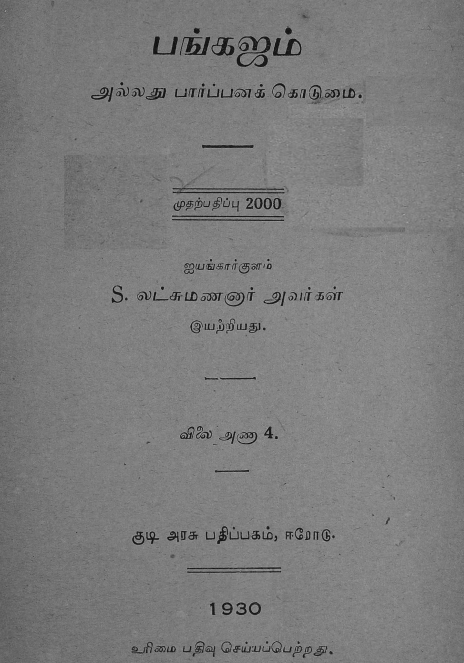
Pankajam allathu Paarpana Kodumai – the play
The author Iyenkarkulam S Latchumanar (Lakshman) wrote this book as a play. Much in the same manner as the later Iraniyan Allathu Inayattra Veeran which was released in 1934.To a mostly illiterate audience plays offer much more effective means to to take the anti-brahmin message. The dialogs appear to be authentic and sensational accounts of what the Tamil Brahmins speak among themselves. The rustic onlooker cannot tell that what he is witnessing is not actual brahmins conversing but Dravidians acting and inventing these roles and dialogs.
The play is not written in an amateur manner but has all the structural elements as a Bernard Shaw play would. It has acts, actors, the locations laid out. The dialogs assigned. All packaged in a book format with a code, printer, preface and so on. The author seems to be fully aware of the vileness and hence uses softening language up front in preparation of what is to come. He quotes Mahakavi Bharathi in the same manner many do today. Bharathi when quoted absolves the person who is about to make a hate speech of all culpability.
The play in 12 acts
The play is set in 12 acts – each of these acts contain the vilest dialogs and plots that the Tamil Brahmin characters are assigned to speak. A masterful exercise in Freudian projection. Projection is a technique where you let out your vilest thoughts through the voice of someone else. Or you accuse the person on the other side of the wicked things that you actually do and think.
The story
There lived a Tamil Brahmin man named Padmagireesa Iyer who was an astrologer brahmin ( Panjaanga Paapaan) . He had a daughter named Pankajam, who was by nature very haughty and arrogant. In order to meet her marriage expense he tried to exploit the non Brahmin in his area by doing various rituals. In addition he would take his daughter to various non Brahmin houses and get them to give her dresses and ornaments. He had a relative Kailasam Iyer who was a personal assistant to a wealthy Naatukottai Chettiar man. They hatch a plot to exploit his generosity by working on his likes and dislikes. Since the Nattukottai Chettiar couple did not have a girl child they liked them. Padmagirieesa Iyer took his daughter and managed to dupe the Chettiar into donating 6 acres of land. The Brahmins tricks of acting as agents of city lawyers and exploiting poor Non Brahmins are exposed. Then they get her married to a Brahmin groom who demanded 2000 dowry, he managed to study ICS. At the marriage of the couple they beat up a poor Non Brahmin who entered and ate some of the wedding food. After marriage the husband goes to a border area for a job and then returns as a Collector to the same town. Pankajam is the defacto Collector her arrogant ways now out in the open. They mistreat and abuse a qualified Mudaliar boy who had come for a job. The now westernized husband now smokes a cigarette and orders a tumbler of brandy – the Collector couple vow never to allow Non Brahmins in the district to progress. Curtains.
As you can see there isn’t much of a plot here. That would require actual playwright skills like Shakespeare and Chekov. The real purpose is to use these situations to spread the vilest anti Brahmin propaganda amongst the masses.
For instance in Act 1:
Pankajam was an arrogant girl.
Well that seems tame. So many plays feature arrogant women. But look at how this arrogance is portrayed in the dialog.

Place: Agraharam house
பங்கஜம்:சூத்திரச்சி எந்நோத்துக்குடி வர்ரது; நோக்கென்ன கண்ணிலே கொழுப்பாடி மேயாது; என்னாஆஆ தின்பாளே பண்ணியாட்டமா!
(லக்ஷ்மி பையில் இரண்டு பாத்திரம் எடுத்துக்கொண்டு ஒதுங்கி வருகிறாள்)
இந்த சூத்திரச்சிக்கு என்ன கண்ணைக்கூட தெரிய மாட்டேன்ரதே; இயூச்சிண்டுன்னாபோரா.
Hey Sudra-chi – endi cant you look where you are going. do you have lard in your eyes. you eat like aaa aaa like a pig. (The servant maid takes two vessels and goes on the side) Pankajam – this Sudrachi cant even see – she is touching me and moving along.
This continues for page after page , dialog after dialog. You can now see that the non existent plot is not important these vicious dialogs are. Now imagine if you are Non Brahmin Tamil in a village who hears this play. You are bound to develop a deep resentment towards Brahmins without question. That leads us directly to the ideological base of contemporary Tamil Non Brahmin society and its receptiveness for anti brahmin content.
Act 2 : All castes insulted and exploited
In Act 2 – a skit is shown where the Brahmin Padmagireesa Iyer deals with a number of villagers and tries to extract money from them for this or that ritual. Once again, nothing much plot wise, but the dialogs are key.

The actors are Natesan – the barber. A poor caste.
Then a Naidu, Mudaliar, Reddiar, Konar, Gounder, Nayakar, PIllai – presumably representing the Non-Brahmin Elite Vanguard of the anti-Brahmin movement.
The act shows how the Brahmin deals with the caste groups differently. Speaking sweetly with the money castes – abusing the Barber and then when speaking with a fellow brahmin abuses all of them as Shudra Paya.
An example of a visceral dialog when the Brahmin dismisses the love the Poor Natesan shows by bringing meager offerings instead of lots of money. He abuses him as Kammunati, Get out.. tries to milk the rich Non Brahmin Elites (Dravidians) for money for various events like annual death ceremony, birth of a new child etc. Finally when all the “Shudra Boys” have left another Brahmin shows up “they mock all the non brahmins and say lets wash the places they sat with cowdung.” You can see how clever this is – in one step creating a Non Brahmin group as that set of people subjected to this injustice. Of course, the lack of logic that life cycle events by definition are are and hence is NOT a site of exploitation unlike day to day farm agristic slavery that the real oppressed endured. You get a new baby once every 2 years – hence you cant be oppressed every day, by definition. The only reason was to deprive some poor brahmins of their income by use of ceaseless propaganda.
Exploiting the Naatukottai Nagarathar Chettiars
A remarkable and persistent theme in this play is the focus on Nattukottai Nagarathar exploitation by Tamil Brahmins. In Acts 5 onwards , the Brahmins guile fully tricks the generous and innocent Chettiar into parting with not just money but land. The principal agent here is Kailasam Iyer the personal assistant of the Chettiar.

The Chetti and Chettichi dont have a girl child hence they love girls, that too from “Nammava” B community. Use that..
Thats why I have brought along Pankajam – the 12 yr old girl.
using the same trick our friend Ganapathi Iyer managed to get a ton of land and money from the Chetti.
The Act goes on and on – as a string of Brahmins come and go collecting various donations. The Brahmins abuse others and among themselves plot to cheat the wealthy Nagarathar Chetty. Now the masterful piece is here : A Non Brahmin audience bystander who himself wants some of that donation goodies may wonder : How is it that the Nagarathar Chetty – who is presumably an insider to the Non Brahmin Volksgemeinschaft not donating to other Non Brahmins. That is covered brilliantly.

ஆனா நான் இங்கே வர்ர வாளை விரட்டி அடிச்சுண்டுதான் இருக்கேன்; இரண் டாவது வந்துதே அந்த தரித்திரத்துக்கு மாசம் 1 ரூபா கொடுக்கச்சொல்லி செட்டி 10 நாளாகுது. இன் னும் கொடுக்காமையே விரட்டி அடிச்சுண்டு வர்ரேன். 10 தடவை இப்படி அடிச்சாக்கே தானா நின்று போகுதுங்கோ கழுதைகொ.
Kailasam Iyer : Chetty is good man he is reading Kudiarasu Dravidian (magazines) and donating to others. But I am here I am preventing and driving out any Shudra. The chetty asked me to give 1 rupee per month to that Daridiram (non Brahmin) but I drive him out , if I drive him out 10 times, he will stop coming to get money on his own accord.
This is uncommon intelligence by I.S. Latchumanaar. It is the brahmin agent or the brahmin peon or the brahmin clerk who is acting as a gatekeeper and preventing the Chettiar patron from helping the non Brahmins. In one sweep, all agency is removed from the Chettiar and pinned on the Brahmin. I have noticed that the highly dubious and improbably Kasi Episode also involved a Chettiar Mutt. In my view, it appears that Chettiars of that time period were somewhat indifferent and uncommitted to the Anti Brahminism, perhaps due to their sponsorship of Temples and Vedic schools and so on. This could have been attempts to bring them around. And boy! was it a success.
In Act 5 brahmin registrar aids and abets stealing Dalit lands
The scene shifts to a Govt Registrar office where land documents are made. Having drafted the land donation from the Nattukottai Chettiar nobleman his assistant Kailasam Iyer gets the land registered. In the office, the sub-registrar is clearly identified as an Iyengar Tamil Brahmin.

சப்ரி:- இந்தப் பறப்பயல் வந்திருக்கானோ அன்னோ?
நரசி :- ஒ; வந்திருக்கான்.
(மண்ணாங்கட்டியை அழைக்க எழுந்திருக்கிறார்)
To show that Brahmins in govt offices openly refer to oppressed with the worst slurs.
Sub Registrar : Has that :para payal come ?
Narasimman: Yes he has ..(rises to call Mannankatti)
These dialogs are highly incendiary as the Tamil word Parapayal (Paraya Boy) is a offensive slur. The play written by S. Lakshmanar a Non Brahmin makes the Brahmin character use in nonchalantly.
Land dispossessed
In the scene in the Registrar office – a scene is shown where the Dalit is deprived of his land by a hurried and deceptive process. His thumb impression is obtained on a hurriedly drafted paper by Tamil Brahmins. This is once again a masterful uncommon inteligence by author S. Lakshmanan – to show that it is the Brahmins who are responsible for the landlessness of Dalits and that the lands the Brahmins hold are Dalits. Which means the non Brahmin elites are innocent and the land they hold are legitimate and outside of Dalit claims.

மண்:- சாமி; ஆடி அரவட்டையிலே கஞ்சிக்கில்லாதபோயி நம்ப ஐயரண்டே 2 பதக்கு நெல்லுவாங்கி காச்சிக் குடிச்சிட்டோம் சாமி! அதுக்கு வட்டியும் முதலும் 25 ரூபா ஆவுதுங்கொ சாமி!
சப்ரி:- இந்தப் பத்திரத்துக்கு ஆறணா ஆறது பீசு.
நரசி:- ஆ, ஆ, இதோ இருக்கு (எடுத்து வைக்கிறார்) (சப் ரிஜிஸ்டார் பெட்டியில் எடுத்துப் போடுகிறார்)
சப்ரி:- சரி, (பத்திரத்தின் மீது எழுகவேண்டியதை எழுது கிறார். பின்பு கோவிந்தன் கையில் பத்திரத்தைக் கொடுத்து)டேகோவிந்தா! ஜாக்கிரதை எட்ட இருந்து விரல்குறி வாங்கிண்டுவா, தொட்டுண்டு வந்து சோப் போரெ; கர்மம், கர்மம்;
In Aadi, when I didnt have anything for my stomach I brought some grain and cooked and ate it. The loan now stands at Rs 25. The Brahmin Narasimmachari thereby takes the land of the Parayar.
Important is the tone : Danger stand away from him and get the fingerprint.. slaps the wrist of the scared Parayar.. insults throws him out after taking the paper. Merciless and crude. Two other Iyengars supply the Witness for the property transfer. Tamil insults ..
Any person who reads this will develop a hatred for the Brahmin characters in the play. Once again remember these are official cultural productions of the elitest of the Non-Brahmins not some riff raff.
This goes on and on .. various specific named communities are insulted, abused, and mistreated. After cheating the Nattukottai Chettiar of land – Panjakam gets married. In the wedding we see a Non Brahmin Aasaari thrashed up by Brahmins because he ate the food. The insults in Tamil supply the real impact.

‘”வல்லார ஒழிப்பிள்ளை, தடியாம்பிள்ளை, ஆசாரித் தாழி மகன், கம்மாளத் தாழிஒழி, வாய்மேல் உதை வயித் தைப்பார்த்து உதை” என்று பல தவறான சொற்களைப் பலபேர் கோபத்துடன் கூறுகிறார்கள்.”ஐயோ! ஐயோ” வென்று ஆச்சாரி வெளியே ஓடிவருகிறார். பார்ப்பனர் தொடர்ந்துவந்து மடக்கிமடக்கி அடிக்கின்றனர். புரட் டிப் புரட்டி உதைக்கின்றனர். ஆச்சாரி ‘பசி சாமி சாப் பிட்டு ரெண்டுநாள் ஆகிறது சாமி” என்று கத்திக்கத்தி கடைசியாகத் தப்பித்துக்கொண்டு ஓடிவிடுகிறார். ஒரு பிராமணர் துரத்தி ஓடுகிறார் )
This is too vulgar for me to translate – but these are the peak expletives in Tamil – have to do it.
Vallara Ozhi, Aachaari Taazhi, Taazhi Ozhi, Kammala Taazhi.. (consider them variants of mother-f…) smash his mouth, beat him on his stomach. Saying that the Tamil Brahmins chase the Aachaari (artisan caste) out of the dining hall. The poor Aachari wails — “swamy, have mercy I havent eaten for 2 days ” yet they beat him and he ran away.
Back to the Nattukottai Nagarathar choultry in Vada Thillai (Kasi / Varanasi)
After the wedding of Pankajam is completed, the bride and grooms father go on a pilgrimage. They end up at a choultry – a religious motel of sorts, established and run by the same wealthy Chettiars in Varanasi. Immediately this reminded me of the famous “Kasi Sambavam or the Kasi incident” that is given as the origin story of Periyar’s Anti-Brahminism. The Brahmins eat their full , rub their stomachs. A character named Sathakeerthi Iyer – clearly a play on Sathyamurthy Iyer of Congress is in the same mutt at that time. He explains to other Brahmins how to defeat the Shudra political power. Just like elephants are use to capture other elephants, he explains how he mixes with Non Brahmins and has many Non Brahmin friends. They will attack the Dravidians by becoming his slaves. In that way, the Brahmins will keep their interests.
There are other acts where a Brahmin woman Rukmini complains how she was touched in a bus.
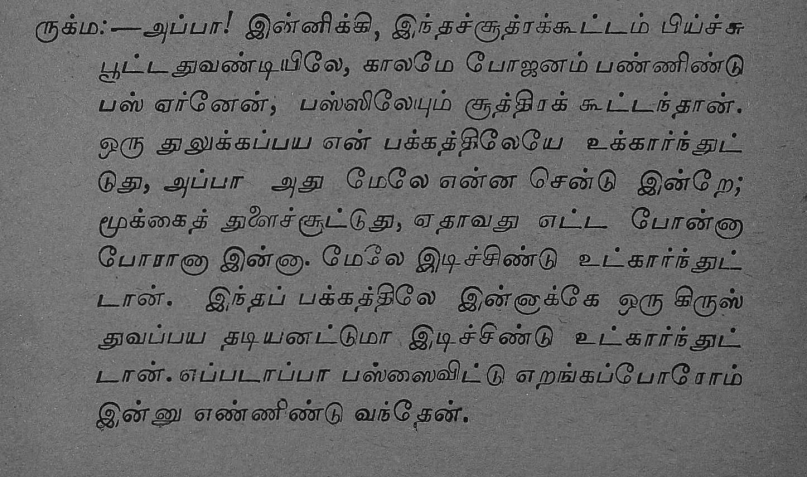
Rukmini: Dad, there are Shudras everywhere now. I got on a bus they are everywhere. A Thulukkan (slur for Muslim) sat next to me and he was wearing a scent, he was touching. Then a Christian was touching against me while sitting. I was waiting for the bus journey to end.
The play ends with Pankajam’s ICS husband who has now changed his name to western A.R.G. Paul ICS (A. Rajagopal). The play shows how Selvaraj Mudaliar an innocent and qualified candidate was prevented from getting a job. The couple then vow to never allow Non Brahmins to ever rise in the district as long as they are there.

Pankajam : (alone in excitement) As long as I am in this district I will see to it that not a single Shudra will progress.
Shudra is transitively –> Non Brahmin –> Dravidian as per their definition.
The End.
The curtains close. The play ends.
The relevance today
One may wonder why is this play relevant today. These are primary cultural productions of the Dravidian movement. In 2024, the Dravidian ideology is not just strong in Tamilnadu but even the Congress Party has adopted the talking points and techniques of the Dravidian ideology [6]. It would be a different matter if Tamil Non Brahmin elite society which has ruled for nearly 100 years would have evolved a more cogent, logical, modern and compassionate view of social justice and abandoned such hateful production. However that has not happened. A mere scan of Tamil cultural productions in YouTube, Twitter, Insta, reveals a doubling down on vulgar hate videos, spreading canards, half lies, full lies against Brahmins. Dravidian Tamil literary and cultural productions of anti-Brahmin are not balanced out by other modern and academic works. Hence these are uncontested. In my Twitter journey itself many BJP or NTK people too seem to have such strong influences from their elders who would have transmitted these within their networks.
The argument of the Dravidian interpreters for Non Tamils cannot claim that these productions were a throwback to a different age when Tamil Brahmins dominated all the other castes. We are seeing it now. We are seeing the police power exercised against examination of the ideology even today. Kudiarasu and later Viduthalai were unceasing in creating the anti Brahmin material. That ideological base is the justification Tamil non Brahmin upper caste society uses for the cancellation of Tamil Brahmin individuals and all cultural elements they touch. Kovai K Ayyamuthu who was the editor for Kudiarasu for a couple of years says that the very purpose of Kudiarasu was to annihilate the Tamil Brahmins. Hence like a person who wanted to catch rats would chase it around the house, destroying the sofas, the walls, cupboards, the doors in an mad rage to catch the rat. Finally unable to find it would raze down the entire house [4]. Even if you we cringe at the rat analogy , the point made by Kovai K Ayyamuthu is totally on dot. There is no cultural element that isn’t tainted by Tamil Brahmins or its very slightly expanded version Brahmin-ism. This extends into glorious Tamil productions of the past, Parimelazhagar’s hoary classical ness (1000 yr) can be cancelled by anyone who writes a exposition of Tirukkural in 2024. Kamba Ramayanam is obscene its antiquity can be overridden by Ravana-Kaaviam, while you are at it take Periyapuranam with you. The temples are obscene and sites of oppression. There is nothing redeeming about anything Tamil because the entire span of civilization is tainted by my forebears. See Silapathikaram.. how can a Dravidian self respecter like it? Look at Madalan Marayon how he controls the king Senkuttuvan. This cancelling process goes on and on and on further and further into new territory gaining new ground. Uncontested. Until the Tamil are left with nothing by shame of their past. I am NOT a Dravidian but I am certainly a Tamil hence I need to guard that. Hence an examination of Dravidian literature is an absolute necessity. I hope all Tamils regardless of caste sit up straight and take notice. Is this art yours? If yes, let the world know it is yours.
References
[1] Naan Kanda Periyar , Kovai K Ayyamuthu, Tamizhagam Publishers 1957, p 26
[2] G. Subramaniya Iyer: The First Editor And Founder Of ‘The Hindu’- Through The Eyes Of The Indian Intelligentsia. R. Raveenthar1 , Dr. G. Rengaraju2
[3] Om Prakash Kashyap at Forward Press https://www.forwardpress.in/2022/01/periyars-powerful-journalism/
[4] Kovai Ayyamuthu “Naan Kanda Periyar” 1957 pp 17 “குடி அரசு பத்திரிகையின் ஓரே நோக்கம் பார்ப்ப வர்களை ஒழித்துக் கட்டுவதுதான். எலி பிடிக்கப் போனவன் எ எந்தெந்த இடத்திலும் பொருளிலும் இருந்ததோதையெல்லாம் அழித்தொழித்துக் கடைசியில்,வீடிருந்தால்தானே எனியிருக்கும் வீட் டையே ஒழுத்துவிட்டாள் எலி இராதல்ல என்று தன் வீட்டையே எரித்துச் சாம்பலாக்கிய கதைபோல கரும் பார்ப்பனுக்கும், பார்ப்பளியத்துக்கும் எங் கெய்கே, எவ்வெவற்றில் வளர்ச்சிக்கும் செல்வாகிற்கும் இடமிருப்பதாகஎருகியுரோ அவற்றையெல்லாம் தவிடுபொடியாக்குவடுதன கீச்சயித்துவிட்டார். சாடு யிலே,அடங்கிலே, சாத்திரத்திலே,கோயிலிலே,குளத் இளே, புராணத்திலே, இதிகாசத்திளே மதத்தியே கடவுள் என்ற எண்ணத்திலே, எங்கெங்கு பார்ப்பளம் நுழைந்துள்ளானே
[5] Pankajam Allathu Paarpana Kodumai, Iyengarkulam S Latchumanar, Kudiarasu Publications 1930. Available online at Tamil Digital Library
[6] “In attempt to rebuild Congress turns to Dravidian ideology”. Times of India April 6 2023 Link
Eradicate Sanathana Dharma like Mosquito Dengue – law creates the politics.
Article 25 of the Indian Constitution guarantees the freedom of conscience, the freedom to profess, practice, and propagate religion to all citizens.
All elected representatives swear to protect the constitution. There has to be a meaning to affirming an oath to the constitution. Now what happens if this resolve is tested? Say a minister from an ideologically powerful state resolves to eradicate a particular religion. Then uses obfuscation, double-speak, euphemisms to explain it away. What institutions should step in?
The Dravidian clarion call to not merely oppose Sanathana Dharma but eradicate it is not new. I have written a detailed blog in 2021 “How can Dravidians uproot Sanathana Dharma in a democracy” It is not a mere outburst but a repeated and organized propaganda campaign. This has now grown so much that the new opposition alliance to take on BJP Modi in 2024- the I.N.D.I.A alliance has been created to take on Sanathana Dharma as per the Tamilnadu Education Minister Mr Ponmudi.

Public fulmination using very violent language – eradication mosquitoes malaria – against a veiled enemy calls for using indirection, euphemisms, and obfuscation. It should alert public to pay attention to what specifically they are talking about. Perhaps the obfuscation is required because the real intention cannot be stated in public in plain terms. This type of indirect language is called an argot used by ingroup members to prevent outsiders from understanding it. A code , cant, or a dog whistle that we call in Tamil குறியீட்டு மொழி (code language).
Here we try to explore this in more depth.
The mosquito and the disease
First, the mosquito.
..some things have to be eradicated not opposed. Mosquitoes — Dengue, Malaria, Corona.
Mr Udhayanidhi in the Eradicate Sanathana Conference
Isnt it strange that the Mosquito a vector is used along with diseases?
Tamil Brahmins have been compared to mosquitoes for a long time in Dravidian source material in Tamil. This is yet another attack on Tamizh Brahmins and through them a proposal for the Tamil NonBrahmin Hindus.
Here is Mr E.V.Ramaswamy Periyar – talking about brahmins and eradication of pests like mosquitoes and bed bugs.
When Periyar was speaking in a public meeting, some one asked him “Are you a Paapaan (slur word for Tamil Brahmin) hater?” To that Periyar replied “Since we cant stand mosquito bite, we are asking to use mosquito nets. Does that mean I am a mosquito hater. Since we are unable to bear the bite of the bed bug (a parasitic insect) we are using insect killer and killing the bed bugs. Does this mean I am a bed bug hater”
This reply removed the darkness of ignorance from the person who asked the question.
Periyar Vaazhvin Velichangal . Dr K. Veeramani Sold on Amazon you can see the quote right there
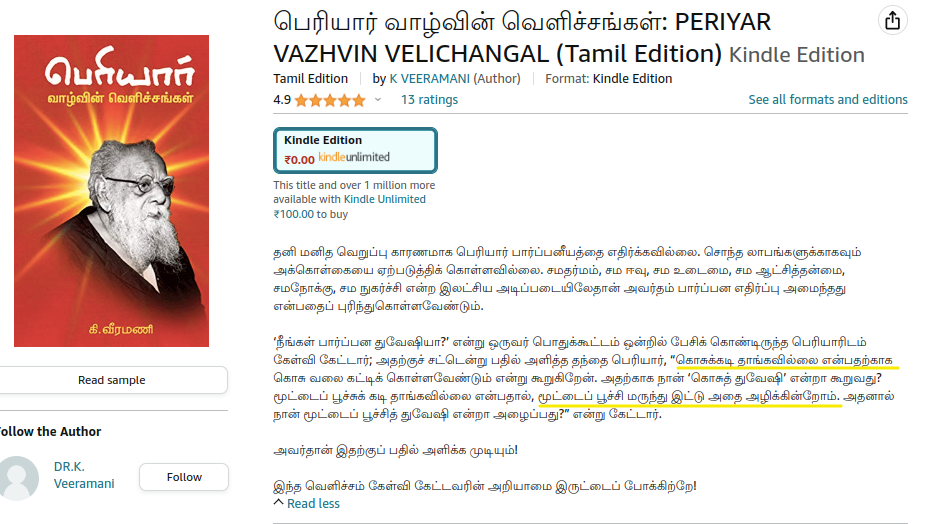
You can see how nonchalantly the Dravidian topmost leaders are comparing Tamil Brahmins as a birth group man,woman, and child to vectors like mosquitoes and bed bugs. Insects and parasites to be protected against and to be fumigated. Like the Nazis, they then claim their hatred is nothing but righteous self defence against the Brahmin pest. This is why I say Dravidian is nothing but an adaptation of anti-semitism. In another video that was found on the YouTube channel MaiChennai a leading thought leadernarrates a similar mosquito discourse between Mr Annathurai who turned reconciliatory towards Tamil Brahmins and the hardline MR EV Ramaswamy Periyar. Mr Suba Vee claims Periyar admonished Anna by saying “how can you say I oppose Brahminism but dont oppose brahmins, can you say that I only oppose mosquito bite but not mosquitoes“.
On 29-12-1938 Mr E.V.Ramaswamy called Tamil Brahmins as “mosquitoes, bugs, and Jews” (Rajmohan Gandhi “Rajaji a life” 2010)

Mr E.V.Ramaswamy (Periyar) writing in the Dravidian periodical Viduthalai :
Brahmins – Newspaper – Political parties – Legislatures and Cinema are the five diseases. These diseases are preying on the human body like the diseases Cancer, Leprosy, and Malaria. If the society is to progress these things should be fought tooth and nail and destroyed completely.
[Viduthalai 9-1-1959 , cited in Translations of Periyar’s speeches and writings Meena Kandaswamy]
Brahmins are a thing like Newspapers, Political Parties, Cinema likened to Cancer , Leprosy. These hate tracts are widely read by the non-brahmin population of Tamilnadu who may be loathe to admit it in public , but when the mosquito comparison is made they are able to immediately access the meaning. When the Cabinet Minister in the UPA govt Mr A.Raja goes one step further and compares Sanathana Dharma to Leprosy, this is the tradition he is coming from.
Theft and the thief – Dravidian-Tamil hatred for Brahmins or Brahminism
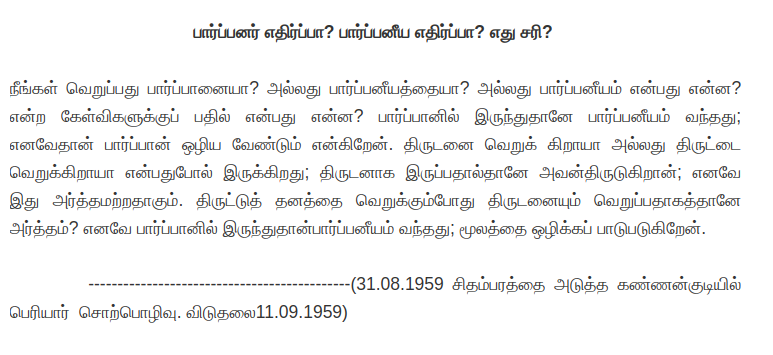
Do you hate Tamizh Brahmins (Paarpanar) or Brahminism ? To that Mr EV Ramaswamy (Periyar) replies.
Why do we say Brahminsm? Isnt it true that it is only from the Brahmin that Brahmin-ism comes? This is why I say the Brahmin must be eradicated. IT is like asking “Do you hate theft or do you hate the thief”? Only because he is a thief he commits theft. If you hate theft you must also hate the thief. Since Brahminism comes from the Brahmin, I am working hard to eradicate the source.
Mr E.V.Ramaswamy (Periyar) Viduthalai 11-09-1959 speech at Kannankudi nr Chidambaram
Obfuscation of Sanathana Dharma – words and their meanin
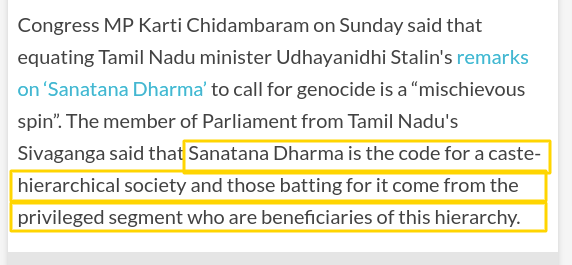
As soon as the furore broke out over the Dravidian vow to eradicate Sanathana Dharma, Mr Karti Chidambaram rushed to clarify that everyone misunderstood the meaning. That in Tamilnadu you see “Sanathana Dharma” simply means caste discrimination. Well, I am from Tamilnadu I do not think so.
The “Sanathana Ozhippu Maanaadu” (Sanathana Eradication Conference) was not an amateur or hurriedly put together affair. It was organized by Tamil Nadu Progressive Writers Association. These are the Dravidian-Tamil literary elite. If in Tamilnadu, Sanathana simply meant “Caste Discrimination” then they would have surely named the conference as “Eradicate Caste Discrimination Conference”. They did not. Another curiosity is the careful title “Sanathana Ozhippu Maanadu” (Sanathana eradication) instead of “Sanathana Dharma Ozhippu Maanadu” (Sanathana Dharma eradication). The omitting of the word Dharma is deliberate because it gives a plausible deniability by omitting the word. Surely the audience can be counted upon make the tiny inductive leap to its actual meaning.
Euphemism, vagueness, split messaging – conveying a message in two parts, are used to conceal what would otherwise be unpalatable or indefensible to the outside world and to its own followers.
Split messaging
Deliver a message which would be unacceptable in two parts.
Taken separately these parts may not fall under hate speech or criminal provisions. This allows plausible deniability, people can deny the parts but accept the whole. To illustrate: The leader of Dravidian-Tamils Dr K. Veeramani said “Sanathana Dharma is Hinduism” and the Udhay said “Eradicate Sanathana”. Instead of one person saying “Eradicate Hinduism”. Taken separately they are not offensive or even wrong – Sanathana Dharma is indeed what we know as Hinduism. And Eradication of Sanathana cannot be called as eradicating Hinduism, it is eradicating Sanathana. Mr Karthi Chidambaram immediately washed off the first part by saying “Dr K.Veeramani is an extreme Dravidian”. This is what discourse analysis looks like.
Choosing to deploy a word that references a thing versus directly naming the thing itself. This is uncommon tactical intelligence.
George Orwell famously wrote that the language and propaganda of totalitarian dictatorship is that of “euphemism, question begging and sheer cloudy vagueness.” He argued that in efforts to “defend the indefensible” totalitarian regimes substitute clinical abstractions for straightforward proper nouns and visceral verbs.
More recently, Berel Lang has referred to “the blatant disparity between the normal connotation of the word and its reference” in Nazi vocabulary, and to “ ‘language rules’ explicitly designed to conceal literal meaning.” He continues that the language of euphemism and deception served not only in internal communications among officials or in messages intended to deceive the Jews, but that “also in addresses to the outside world . . .
Prof Jeffrey Herf. Univ of Maryland. Goebbels and antisemitic campaigns of the propaganda minister
What can be eradicated
A large number of Dravidian Tamil intellectuals came forward to define, redefine, and soften the meaning of the word Sanathana Dharma. Karti Chidambaram, Sugi Sivam, Jeyamohan and others who represent a cross section of the elite castes clarified along the lines that ‘We Tamils do not identify Hinduism with Sanathana Dharma it refers the Vedic religion of the Brahmins only”. To buttress this Jeyamohan supplied evidence that Vedas were not central to Non-Brahmin (Dravidian) Tamil Hindu. This was rebutted instantly. The basic argument from the Dravidan side was “Sanathana Dharma refers to Vedic religion, of the Brahmins”
If Sanatana Dharma is not the Dravidian-Tamil religion that makes the eradication call even more problematic. If Sanathana Dharma which is an indirection used to reference Vedic Hinduism. If that is external to the religion of Dravidians and the religion of the Tamil Brahmin only, then a conference to eradicate someone else’s religious belief is an outright contravention of Article 25 of the Constitution.
Why bait Hindu if they only hate brahmins?
A good question asked by a friend on Twitter. This probably requires a dedicated post. The short answer is “Dravidian” and “Idea of India” is about transformation of the society. This is a marxist concept. Through attacking brahmins and vedic they would surely unsettle the Non Brahmins too. However they can alleviate or privataly reassure them by saying that their offence is limited to Brahmins only or that is it only a mask. They will be given a new religion without the Vedic bits as Jeyamohan and Suba Vee and Pazha Karupiah says. Perhaps they will excise “Sottrunai Vediyan” and create a new religion for Non Brahmin Tamils, but that is a concern for later. They have been set on the slippery slope. They will be taken care of and civilized properly.
What can be eradicated specifically
In concrete terms what can be done to eradicate a faith? As we stand now, even with zero action on #core agenda explicit laws cannot be passed banning the possession of religious material, propagation of the same via schools or shloka classes, public display of symbols, etc. What can be done is to encourage extreme and vulgar polemics on that faith system. In critical theory, sustained high intensity attack on any cultural aspect of a society will eventually wear it down. This is a Gramscian Marxist theory to first infiltrate institutions and destroy the cultural hegemony. This is possible by the seeming defacto immunity from criminal codes IPC 295 ( religious enmity) and IPC 153 (group enmity). While brutally jailing any defensive response using the same sections.
Law creates the politics – the Supreme Court and Dravidian invective
In April of 2023, the Supreme Court of India with great bombast called the Centre impotent for failing to curb hate speech. It also threatened to file contempt against police officers failing to register FIRs.

First here is speech and there is propaganda. That is the difference between a comment and a crusade. Judges are supposed to be alive to such distinctions. Even if vile and vicious, a sudden outburst of abuse against a community is not the same as organized, sustained, state supported propaganda crusade against a group aimed at destroying the dignity of that group. That is the unique feature and the real force behind Dravidian power.
At this time a Dravidian organization has organized hundreds of street corner meetings, conferences, speeches, and online campaigns to eradicate Sanathana Dharma. Then covering up with obfuscation that they actually meant caste discrimination. Caste discrimination is not an inalienable part of Sanathan Dharma, quite the contrary it is only Sanathana Dharma that provides redressal and equity in the form of reservations. To suggest that caste discrimination is not a severable part of the entire Sanathana Dharma tradition is egregious.
Using verses from Manusmriti to adamantly insist that these are real world concerns of today exactly mirrors the Nazi Anti-Semites who used Talmud polemics to justify anti-semitism. Nevertheless all the evils in Manusmriti are common offences today. They are severed and outlawed by criminal laws and civil laws. This reeks of the same “look what we found” to nail you hate propaganda justification.
Free speech or not
Political activity take place in the space created by the court. By all counts “Eradicate Sanathana Dharma” has moved the overton window – the range of political possibilities by miles. Now this is in public debate space. Excuses , qualifications, and clarifications should be in court and not in public. Such public debates about the desirability of eradication will certainly not be allowed for other religions. For example an “Eradicate Islam-ism” and then covering it with ‘we only spoke about the violence” or “Eradicate Christianity” and then fudging “we reject the common word christian there are only protestants, catholics, adventists etc.”.
This “space” is created by the court and Dravidians and their I.N.D.I.A alliance have rushed to occupy this new territory. BJP is trying to take the defence side in response. But in reality this is a matter for the court and police. I contend that to the extent the Dravidian ideology is based on Anti-Brahmin propaganda it is a creation of the legal immunities.
The free speech absolutist would say even if Dravidian-Tamils call for eradication of Hinduism or Brahmins the speech should be protected. Rule of law however is concerned about the uniform application of this principle. The Dravidian government is extremely brutal in arresting dissenting speech. There can only be all-in or all-out in terms of free speech. An example would be Malaysias’ 3R law where all critical content on Race Religion and Royals are taken off the table. Recently Dravidians were warned not to do their anti-hindu and anti-brahmin spiel in Malaysia by their Malaysian hosts. This is an example of all-out. USA in an example of all-in. There is no intermediate state. If X can provoke Y and Y’s reaction is criminal then you can never defeat X in elections. Because this means X’s campaign is valid and Y’s campaign is illegal.
In India, free speech laws follow demonstration of violence potential. If you can show mayhem then perhaps the provocation is banned. However this means insofar as speech laws the appellate authority is the mob not the court. Because the court defers to the mob.
Reversal of logic – drawing a premise
There is another real danger to the discourse that BJP and other defenders of Sanathana Dharma will miss. Stay with me as I explain the dangerous death of logic.
Julius Streicher the notorious anti-semite was hauled to court when his magazine Der Sturmer kept publishing the Blood Libel canard – which accused Jews of killing German children for their blood. During court hearings in front of a German jury he astonishingly claimed the following defence. He had seen a painting of the blood libel by a famous artist in a Vienna city hall. He said “If the blood liberal werent true, would a painter have painted it? would a respected government exhibit in the city hall?
Julius Streicher, Randaal L Bytwerk Page 47
Isnt it an astonishing logic? It will easily catch with the poorly educated Indian masses in the hands of a master propagandist who will deliver it. It is rooted in non uniform application of laws.
Goes like this:
If a call for eradication of Sanathana Dharma was not a constitutionally valid agenda, then surely our esteemed judiciary which shows no favour would have done something about this call. Since this is allowed, eradication of sanathana dharma might be a legitimate call.
These are issues that fall out of the central anomaly with the “Idea of India ” jurisprudence. A lack of principles, abstraction, and lack of commitment to uniform application.
The BJP in 2024 could be in for a nasty surprise at the newly opened territory. There is a great energy that has been unleashed. Tamilnadu has shown that masses and groups will adjust to the new normal of degraded, vulgarized discourse and sue for peace and protection. The same riddle “how can seemingly devout Tamils vote for a group with such offensive rhetoric” can also apply to other states. The propaganda makes it happen.
Acid Thiagarajan story – Dravidian elites valorising Dalit attacking Tamizh Brahmins
One of the common themes we hear from both Dravidians and their New Delhi allies is “But no one got killed”. When pushed, they retreat to “there were no violence”.
For an actual Dravidian Discourse Analyst like it made absolutely no sense that a movement that is built on announcing malevolent intent via propaganda 24×7 would not have capacity for actual graded violence. Would anyone merely announce their mens rea (Criminal mind) but not have any capability to back it up.
Here is a leading mainstream Periyarist Dravidian organization celebrating a terrorist act of physical assault as a way to inspire more such assaults.
Background – the public prosecutor Srinivasachari
Periyar (EV Ramaswamy Nayakar) made a speech calling for murder of atleast 3000 Tamizh Brahmins and arson of their houses besides calling for burning of Indian Constitution. Following this legal action was hesitatingly taken by the then Congress government in Tamilnadu upon prodding by Jawaharlal Nehru. The judge then sentenced Periyar for 3 years jail. The Public Prosecutor who appeared for the TN Government was a Tamizh Brahmin by name of Srinivasachari. This Dravidian hero in an act of revenge threw acid and assaulted the Tamizh Brahmin prosecutor.

Punched and threw acid on Srinivasachariar face ..
The story is recounted in Tamil. I have translated to English below.
If it is Vanchinathan for you !
It is acid Thiagarajan for us !!
My dear Comrade Sinnasami stood with me. We were getting ready for a big plot. Do you know how much money we had ? Four Annas. I heard the news first hand.
Periyar did not announce anything about Viduthalai (a signal of sorts) but I heard news that a Government Lawyer was to participate for Republic Day celebrations. I told my friend Sinnasamy “I have decided. You please leave from here. Long Live Periyar we saluted and shook hands and took leave
Then Sinnasamy pulled me aside and refused to take leave from me. He said “Let me also join you” At that time I said “No please you leave, I have forgotten even my mother and for me only Periyar is important now”
Mr Srinivasachari participated in Republic Day celebrations and was returning. Then, in front of police view itself I grabbed his neck and strangulated him. I screamed “RASCAL” to his face .. then I threw ACID on his face. When he fell down the 8’O clock siren blew. Then I punched him on shoulder and face. Then 300 people chased me.. they could not catch me.
Then police took me for investigation. The Police inspected was very respectful to me, he made me sit equally and put his arms around my shoulder. Then he asked ” There are so many Periyar cadre, why are you so concerned more than them. Why are you alone doing such extremist acts”.
Then I told.
You are from lowered (Backwarded) community I am from oppressed (Dalit) community. You have now made me sit as equal and put hand on my shoulder. 25 years ago I was untouchable. That has been given by Periyar to me. I said.
Original in Tamil

Guile and very fine tuned messaging
This is not a normal outburst. Both the message and delivery are results of very fine tuned propaganda methods. Note the following.
- Vanchinathan is for you – like that Acid is for us. Where you = Brahmins? us = NonBrahmins (Dravidians) ? See how this message is delivered? That fighting a foreign imperial power is on the same level as killing a citizen. If the Dravidian-Tamil argument is that the Tamil Brahmins are not citizens of India but need to be expelled. Then it is incumbent on the Indian state to protect itself.
- 8’o clock siren – this invoking of a factory industrial metaphor is to rouse the communists and attach themselves to anti-semitic like Tamil Brahmin hatred.
- Police being kind – to seed the impression that Tamilnadu Police is sympathetic to Dravidian criminal assault on Tamilzh Brahmins. This can be used to convey ‘dont worry, police is on our side’ and hence attract criminals.
- Dalit as soldiers – the actual criminal Thiagarajan is making an absurd statement to appear to be a reasonable excuse. The police inspector is OBC .. and the criminal a Dalit. The Dalit justifies acid attack on the Tamizh Brahmin Lawyer Srinivasachari as the method due to which the OBC who treated him as untouchable is being nice to him. The straight line logic is that the Dalit should hit the OBC who oppressed him.
Police sympathy with the acid attacker theme
This says “rhe police inspected who was smoking a cigarette in front of me also started crying..”
This story is carried in Kalaignar News – a leading Tamil media outlet.
The tamil has a spelling mistake முன்னாள் instead of முன்னால் – a propaganda theme that hints to potential cadre who can supply the actual criminal capacity not to fear the Police as they are also aligned.
As per (1) , after the incident Acid Thiagarajan hid – then Police caught him and later he was released for lack of evidence. Apparently Periyar himself paid for the lawyers.
This criminal was honored in a stage of Dravidian organizations.

There is a genius at work behind this.
In cahoots with Law and Order
In cahoots with Media.
Dravidian Tamils openly celebrating an activist who boasts about his plan to Kill Nehru
Further , this Trichy “Acid” Thiagarajan has proudly supplied testimony how he plotted to kill Nehru. It goes like this (as per the blog )
Yes, during the Hindi protests in Tamilnadu. Nehru had called Tamils as “nonsense”.
As usual , I got furious. Right at that time Nehru happened to visit Trichy. The day prior to his visit to Trichy men were guarding the railway tracks with lights. I hid near the railway tracks out of sight. I had a bomb attached to a rope. As the train with Nehru approached I planned to toss it into the tracks. Then the train with the Ashoka Chakra emblem rolled by. To toss the bomb I got ready and looked up – it is at that moment I saw at the compartment door Kamaraj standing majestically with arms on hip. I remembered then that Green Tamizhar (Original Tamizhar) Kamaraj was supported by Periyar. So I dropped the bomb and started crying.
This story appears in a Dravidian blog –


Invited as a guest of honour in Dravidan conference in 2007 Tanjavur
Apparently this Acid Thiagarajan was invited as a special guest where he made the speech boasting about his attempt to murder and also other stuff.
What matters is :
- If this is bravado and falsehood – it cannot be of relevance
- The bravado is seen as an act of virtue and hence is celebrated because they want people like this.

Sources :
http://acidthiyagu.blogspot.com/2009/03/blog-post_3941.html (saved backup PDF)
https://www.vikatan.com/government-and-politics/periyarist-acid-thiyagarajan-passed-away
https://www.kalaignarseithigal.com/tamilnadu/2020/02/26/periyarist-acid-thiyagarajan-passed-away
Dravidian source literature is nothing more than hate screeds
I have written earlier about the obsessive references to prostitutes in E.V.Ramawamy (Periyars) own writings. While this is blindingly obvious to any reading the material and listening to the discourse in Tamil itself. “Collected Works of Periyar” brings it to you in English. You can see how faar out Dravidian writings are from civilized discourse.
Recurring theme of prostitutes in Dravidian ideological source material
The purpose of Dravidian material whether in book form, pamphlet, tweet, video, movie, or any cultural output is to vulgarly abuse and spew hate material towards the Tamil Brahmins. This is systemic in the sense it is everywhere and it is used to explain everything.
Reference list
I collected the references to “Prostitutes” in the Collected Works of Periyar book.
Quite stunning. The Tamil Non-Brahmin society has chosen Dravidian ideology and Periyar. Would it not be demoralizing to both consume and deny ? You can as a group insist to believe a falsehood – but you demoralize yourself.
references


Vulgar obscene hate in Tamil – prostituting wife
The Non-Brahmin tamils insist vehemently that Periyar was a feminist. That their ideology is only about social justice. That they are merely defending themselves against a very powerful minority Tamil group. That they only want representation for non-Brahmins.
All that is fine and dandy, but that is not what the direct evidence says.
Here Periyar (representing the backend NonBrahmin-Dravidian intellectual forces) says “Tamil Brahmins prostitute their women to Non-Brahmins. Note how prostitute is used as a verb here.

Is this the hoax of the millenium??
Iraniyan Allathu Inayattra Veeran – a nefariously hateful Dravidian retelling of Narasimha Avataram
In the new 2022 book The Rule of the Commoner – DMK and the formation of the political in Tamilnadu 1947-1967, Cambridge University Press – Rajan Kurai Krishnan the principal author interprets the play இரணியன் அல்லது இணையற்ற வீரன் “Hiranyakashipu the matchless hero” to an English speaking audience.
I was quite shocked to read how he wielded considerable word skills to appear to discuss the plot of the play but never touching the vile and vulgar anti-brahmin hate propaganda that underlies the play. The author plays down the techniques of the play simply as a Non Brahmin Dravidian response to “Aryan Brahmins re-narrating ordinary events with infusion of supernatural elements”.
The reality is only known to Tamil anti-Dravidians like myself who actually read the original play in Tamil. The play has very little to do with the Hiranyakashipu Prahaladan or Narasimha avataram. The play spreads vile narratives about the guile of Tamil Brahmins who use their women to deploy sexual seduction techniques. This followed by a screed of repeating the usual Anti-Brahmin canards in Act after Act. The anti-Brahmin is not even subtle or insidiously placed as you would find in the Nazi film Jud Suss (1940).
Follow me as I show you what the Play was actually about and the centrality of the play in Dravidian ideology.
Iraniyan allathu inayattra veeran ( இரணியன் அல்லது இணையற்ற வீரன் ) 1934 ; The Matchless Hero Hiranyakashipu
This play was a watershed moment in the Anti-Brahmin / Non-Brahmin movement. Those who are curious about the ideological foundations of the remarkably resilient “Dravidian Movement” never bother to stop and seek to see the sources. This play is one of the fundamental sources of the Dravidian movements argumentation.
This play was first staged on 9-9-1934 in front of Mr. E.V. Ramaswamy “Periyar” in VP Hall in Chennai. This play was written by one of the leading intellectuals of the Dravidian movement Bharathidasan (Mr Kanaka Subburathinam). There is a University named after him today. However, the play was conceived and produced by Mr S. Gurusamy Mudaliar “Kuthoosi”. One of the most energetic , prolific, and creative producer of Anti-Brahmin material in my opinion. From 1927 to 1965 Mr S. “Kuthoosi” Gurusamy wrote over 5000 essays drilling the same canards and accusations in ever different ways. His influence on Barathidasan was considerable.

Mr S. “Kuthoosi” Gurusamy himself played the title role. The supporters and cast features the who’s who of the Non-Brahmin Educated Tamil elite of that era. The play was screened in front of leading intellectuals such as K.M. Balasubramaniam, T.Sambandam, T.N.Raman. It was also staged in front of P.T.Rajan. Mylai Seeni Venkatasami (Naidu) raved about the play as “unsurpassed” for its content tailored to the underclass to rouse their passions.
Before we look into the play – we need to understand the Prahalathan story that is the Narasimha Avataram story.
Narasimha Avatar and the story of Prahalathan
A quick recap of the story of Prahalathan (Prahalad) is in order here for completeness of this article. In my view the Narasimha avatar is one of the most philosophically profound stories in all of Hindu texts.
Narasimha Avatar is the story of the supreme Lord manifesting as a half-lion half-man to put an end to the tyranny of the narcisstic King Hiranyakashipu.

It goes like this. A narcissistic King does great penance to Lord Brahma and obtains a boon. That he cannot be killed in Day or Night, by Man or Beast, indoors or outdoors, by metal or by wood, on earth or on sky, and so forth. Sounds like he has plygged all the holes ! He has a young son by name of Prahalad who is a devotee of Lord Narayana. He refuses to obey his fathers various laws in his Kingdom. Laws were put in place where the people were forced to worship him and the sole God. Various attempts to reform Prahalad failed. Things move towards a spectacular showdown. The King Hiranyan demands to know where the Lord Narayana is – to that the child Prahalathan says “he is everywhere even in this pillar”. It a fit of rage the King kicks the pillar setting in motion the fearsome manifestation of the Narasimha Avatar. All the boons obtained by the King from Lord Brahma are nullified as the fearsome Lion-Man who is neither man nor beast, grabs the King and places him across his thighs neither earth nor sky, plunges his nails – neither metal nor wood – in the twilight. Neither day nor night. Many have expounded on the philosophical and psychological aspects of this remarkable story.
In fact the great Tamil poet Kamban goes one step ahead of the others in describing the scene. In one of the famous verses of the Kamba Ramayanam he goes
“சாணினும் உளன்; ஓர் தன்மை, அணுவினைச்
சத கூறு இட்ட கோணினும் உளன்; மா மேருக் குன்றினும் உளன் ;
இந் நின்ற தூணினும் உளன்; நீ சொன்ன சொல்லினும் உளன் ;In response to his fathers demand to know where this Lord exists Prahalathan says “He lives in the span of a hand, also in that tiniest of particles that is a result of split the tinest of particles into a hundred parts, he is in Meru mountain, in this pillar and also in the words that you just spoke” Surreal Kamban! I say this to indicate that the legend of Prahalathan is deep in Tamil psyche for millenia. This is not something recently infused that the Dravidian Anti-Tamil-Brahmin vanguards sought to demolish. They want to rollback to a checkpoint 2500 yrs ago, not merely 200 years. In the process they steamroll and destroy all that is worthy in Tamil such as Kamban.
Lets move on to the actual play.
Kamba Ramayanam 6312 – a famous verse
The plot of Iraniyan .. Chitrabanu the Aryan Brahmin (TB) seductress
As per the lore, Prahalathan was merely a 5 year old boy. The first thing the elite Dravidian playwrights did was to ignore this. It is hard to overlay a story of female seduction on a boy. This is a feature on can observe in Dravidian arguments to this day. An appeal to the prurient. They figured out quite correctly early on that the uneducated masses could not be presented a nuanced or logical narration. The vulgar and the prurient mixed with vile stereotyping of an identifiable group would serve the purpose.
Enter the real protagonist of Iraniyan. A fictional seductress named Chitrabanu. The main character.
The story goes like this.
Hiranyan was a just Dravidian king who believed in self respect. In preparation for his coronation he sends Prahalathan to visit neighboring kingdoms to learn the systems in place there. Accompanying the prince is his Tamizh Brahmin schoolmate and close friend Kangeyan. While taking rest in a beautiful garden the friends come across a damsel in distress Chitrabanu. Using her beauty and sweet talk she makes Prahalathan fall in love with her. The prince is then secretly married by the Aryan Brahmin clan leader and Chitrabanu’s father Gajaketu.
The prince Prahalathan is blissfully unaware of the treacherous ways of the Aryan Tamil Brahmins. In reality, the beautiful Tamizh Brahmin woman Chitrabanu is the sister of his close friend. The brother and father deployed the beauty to ensnare the prince. The friend pretends to not even know his own sister. True to the nature, the women has also seduced the commander of the King Hinranyakashipu.
Meanwhile there is turmoil in the Kingdom as Aryan Brahmins (Tamizh Brahmins) have waylaid the highway and are raising slogans in praise of their Lord and putting down the Dravidian. The enraged king orders mass arrest of all and issues various orders to punish them. Such a gouging out the eyes, chopping the hand, beheading, etc. The Tamizh Brahmin (Aryan) seductress Chitrabanu who has also entrapped the Dravidian commander in her beauty, manages to free all of the convicts.
On the day of the coronation, the prince Prahalathan revolts and mentions the name Lord Narayana. Guided by Chitrabanu in mans clothing. The enraged King Hiranyakashipu gives the boy a day to recant. This leads to the final act where all the actors are mixed up in a chaotic melee. Prahalathan says the Lord Narayana is also in the pillar , then he kicks the pillar and out jumps a clown wearing a Lion costume. He is none other than the brother of Chitrabanu ,the student Brahmin friend of the prince. The King laughs at the clown and kicks him hard. The costume flies and the brother dies. The king haughtily asks in a Punch Dialog “If I kick the Pillar – Narayana appears, If I kick Narayana will a pillar appear”!
Then a scuffle ensues as the cowardly brahmin crowd stabs the King from the back. He dies, The Dravidian queen commits suicide. The commander on seeing Chitrabanu weeping for her brother finds a note. He discovers he is being two timed by Chitrabanu and Prahalathan. He stabs Prahalathan who dies. Then he commits suicide.
Play in acts
Now plays are not narrated in the way I just described the parts. The dialogs, songs, emotions, costumes, and the way they are delivered are the key to reaching inside the audience’s minds. Now let us see actual dialogues and songs from the play. You can see that the play itself is only a vehicle to transmit vile Anti-Tamizh-Brahmin thoughts and seed them deep into the Tamil working classes.
Since they are in Tamil,let me translate them for you.
Disambiguation of Aryan as Brahmin. A redirection technique.
For a hate propaganda to work the disgusting evil has to be traced to an actual contemporary proximate living group. Aryan does not sufficiently do that. Are Mudaliars or Naidus or Vellalas Aryans ? Are they talking about Trump, Biden , Churchill, Napolean as Aryan. Or even Nehru, Rahul Gandhi , Sachin Pilot. Of course not.
So while the play uses Aryan in most places there is a clear disambiguation provided in the first act itself when the treacherous friend Kangeyan introduces himself as a timid Aryan Brahmin.

Our bravery is to use women to seduce
In the act where the secret marriage of Prahalathan takes place with Chitrabanu, the play features a dance to this song.
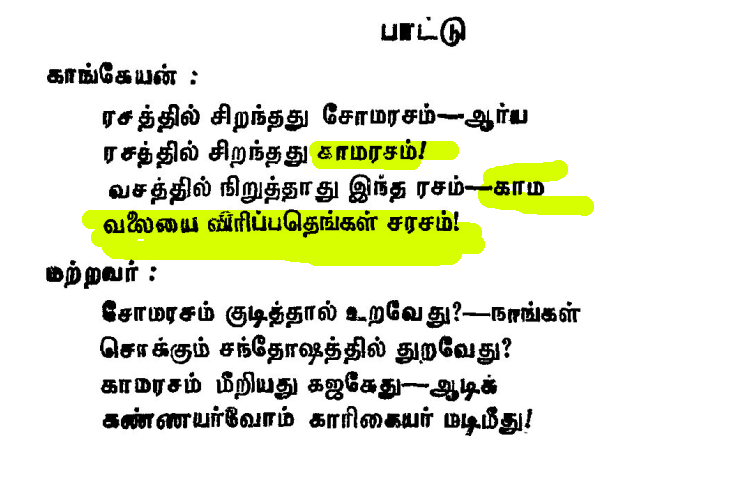
The song says “to spread the web of sexual seduction is our bravery” , “after drinking the soma rasa – there are no relations” ; This is a way to seed a stereotype of the Aryan (redirected from Tamizh Brahmin) as a promiscuous drunken rave community who use their women. Chitrabanu’s own father does not think twice about deploying his daughter in such a sleazy double affair seduction. Neither her brother who uses his sister to seduce his friend.
Dogs .. those who fattened themselves
Remember the act where the Dravidian Non-Brahmin Hiranyakashipu sentences loads of Aryans (Brahmins) to various sentences. That is nothing but a stage for propaganda. The propaganda here is to use the mouth of the leader of the Dravidians “Iraniyan” to state his preferred solution to the Brahmin (Aryan) problem.

Daily those who have grabbed and stolen and fattened themselves. These dogs who are sticking to the nation and sucking and blooming.. these dogs.. take a sword and chop off their two arms.
This is how the story so innocuously narrated by the Dravidian interpreter Rajan Kurai Krishnan actually sounded and was taken to the people. Dogs, parasite memes..
Eradicate every root of Aryans from this land ..
In the same act,, the thoughtful Dravidian minister says how to go about dealing with the Aryan (redirected to Brahmin) threat.

The Minister to the King Hiranyan: At this very moment, we need to eradicate to the root Aryans from this land.
The King concurs : You are right Minister
In the final act, the commander does a monologue. That calls for outright eradication of Tamizh Brahmins from this land and turn the land into “For Tamils only”. Once again keep in mind the redirection technique I explained earlier. Aryan here has been disambiguated. Failing which the actors or support staff can simply whisper into the crowd who they actually mean by Aryans .. it isn’t Churchill or Joe Biden they are talking about.

Eunuchs.. Cunning foxes.. by birth unmanly.. goes on..
The play attacks Aryans once again a proxy for Tamizh Brahmins as Eunuchs, without male parts, fox crowd..


You can notice the accusation is eerily similar to Anti-Semitism .. accusing a group of trying to bring the entire world under their control.
Brahmin (Aryan) women f.. multiple partners
The Dravidian-Tamil king informs his people about the qualities of Aryan (i.e. Tamizh Brahmin) women in a fiery monologue thus:

Curious sexual elements of Chitrabanu
Since the play is the product of the finest brains of the Non-Brahmin elites, I was pretty sure there would be hidden meanings. One of the curious elements I noticed was the odd behavior of Chitrabanu (the Brahmin seductress of Dravidian Prahalathan and the Commander)
She never really put out !! But she was a tease.
Her tease is carried in a titillating manner in the play itself. Using a Vratam
Denial of physical relationship using some religious excuse
You see Brahmin women are not even proper seductresses rather just teases.

During her interaction with the commander, she seduces him with hugs and offers another Kiss. During the most desparate times she even declares her temporary vow of abstinence to be over! In order to save her clan. This is to show the the piety of the Brahmins is bogus. They will discard it in a moment if push comes to shove.

I think this is what happens. It is brilliant !
If Chitrabanu was shown as actually marrying and copulating with a Dravidian-Tamil prince. Then it turns the present day Dravidian Non-Brahmin elites into a mixed race. What could be worse than that. You see the lack of logic ! The obvious way would simply be for Chitrabanu to feign Tamil-Dravidian and then marry Prahatlthan and then become the queen. There is no need to murder Hiranyan cause an uproar! But it is irrelevant – the purpose of the play is to transmit the laundry list of vile canards on Tamil Brahmins using the Aryan redirection technique explained above.
The Dravidian-Tamil weakness for fair skin women..
The final part : the Dravidain Queen Lilavathi asks the Dravidian-Tamil King Hiranyakashipu innocently. /i

The Queen Lilavathi asks innocently : I am unable to understand why Tamilians are falling for Aryans words !
The King Iranyan (Played by Kuthoosi Gurusamy himself ) would then say : Aryans use their women to entrap young Tamil men. The Aryan women are fair skinned. They go after the Kings using cunning..
Conclusion
The play Iraniyan Allathu Inayatra Veeran is the vilest example of Anti-Tamizh-Brahmin propaganda. This is not merely a random play but a trend setter. Even before C.N. Annathurai used the medium of plays for propaganda Kuthoosi S. Gurusami and Bharathidasan wrote and staged this play all over Tamilnadu. Several of the tropes I find on Tamil social media such as “பெண்களைக் கூட்டிக் கொடுத்தல்” (sending their women) can be traced to this play.
In 1948, the Governement banned this play and the book. The Dravidian interpreter Rajan Kurai Krishnan calls this a ‘repressive measure”. The ban was lifted the moment DMK came into power in 1967.
The play lacks nuance, logic, any philosophical message, or social justice imperative. It is not even true to the original story it wishes to rebuke. The chief trick being the need to turn the five year old child Prahalathan into an adult in order to overlay a amorous story. The chief character is Chitrabanu a completely fictional creation. None of these matter – the Prahalathan story is merely a canvas or a medium to propagate toxic Anti-Brahminism. If not this story, some thing else – just replace your favorite demon say Surapathman. The story can be readily adapted.
In recent years, there is renewed effort to stage this play across Tamilnadu. It has been staged in Cuddalore and other places. The play is available in book format all over the internet. Online the Tamil Virtual University features it. In 2019, The Hindu ran a feature about the renewed push to reintroduce this play.
Moral of this blog : Always double check and triple check the Dravidian English interpreters. Check in Tamil directly.
Dravidian defensive responses to exposure of ideology
Any counter propaganda effort requires stamina. Hate propaganda such as the Dravidian ideology is built on telling numerous small lies continuously. The sheer cadence would be overwhelming. Which is why Dravidian elites exhibit hyper vigilance traits.
A really well written Twitter thread was doing the rounds a couple of days ago by Shyam Sekhar :
The thread goes on to say how the most privileged castes using Anti-Brahmin hate propaganda were able to create an alliance where they became the leaders occupying all top positions and in the process disenfranchising the Tamizh Brahmins. His thread is absolutely spot on. This is not an upper caste verssus lower or oppressor versus oppressed. Dravidian movement is Tamizh Brahmin versus Non-Brahmin-Upper-Castes. Which is why you see the Cabinet is filled with Non Brahmin Elites !!
Another key point to note is the complete disregard to the lived experience epistemology of the Tamizh Brahmin. In plain English – the actual lived experience of Tamil Brahmins under Dravidian Non Brahmin Elite rule counts for nothing. The non Brahmin elites who I track simply joke about this or share some troll memes. Even when presented with direct evidence of their own leaders from their own castes literally calling for killing of Tamizh Brahmins or proudly recounting cases of criminal physical assault such as forcibly cutting the sacred tufts.
However the lived experience ‘life stories’ of Dravidian Non-Brahmins are elevated sky high. The origin stories of Non Brahmins go like — I spent so so time in close proximity to Tamil Brahmins and <insert> of a psychlc harm happened to me perpetrated by some Brahmin individuals. Now do you blame me for being so resentful ? The spurious “Kasi humiliation sambavam’ of Periyar himself is case in point. Such a weak and dubious story on which an entire century of hate hangs.
Lack of logic and reason
Here is typical response from a leading account @sujays.

If anyone would spit out an ad-hominem snark at “Avani Avittam” in a response to a narration, that should popup dozens of red flags all over the field. It is the clearest indication that the attitudes spring from a different place totally unrelated to social justice which is a civil issue. Even trying to subsume, drown out, and divert the valid claims of social justice. The Avani Avittam event ifself ought to be of no consequence to any one except the anti-Brahmin. Merely a unique custom takes place in any group. As Sartre said : “it isnt evil as much as it is unique”.
Regardless, one would expect rationalists and profuse readers and writers to be able to put together a proper tweet thread or a blog in English or Tamil. We are talking about highly educated and professional Dravidians here not my erstwhile Tamil sparring partners of ArakkarPeriyar, RajuBhaiDMK, IVedaalan etc.
Could this be the problem? The ideology itself cannot be articulated in a rational and civil manner. Only by slurs, smiles, insults, .. seeking to unsettle and unnerve.
What @shyamsek says is nothing new
The landed non Brahmin aristocracy who founded and fuel the Anti-Brahmin propaganda while at the same time exulting at the 100% pure Non Brahmin MLA in Tamilnadu need to be studied. To this group – prestige was tied to land. But that isnt the case anymore. Through sheer intensity of Anti-Brahmin tactics like thread cutting, continuous threats, insults to women, they did achieve one goal is to dispossess the Tamil Brahmin landowners. They moving on to greener pastures isnt the issue. The Anti-Brahmin propaganda is the issue.
The anti brahmin saturation hate propaganda along with implicit exclusion rules – from the DMK particularly and less so from the shadow party AIADMK – and unwritten rules about ‘அதிகாரப் பதவிகளில் இருந்து அப்புறப்படுத்துதல் (removal of Brahmins from authority positions) are not merely loose talk. Mr E.V.Ramaswamy( Periyar) himself wrote editorials complaining that dropping of caste names made it difficult for interview panels to spot and remove Tamil Brahmins. This does not apply to other so called oppressor castes. That is the magic of Dravidian ! They are cabinet ministers in DMK today and call Brahmins pejorative names as “nooliban”.
Irschik has written about this. Sedentariness was seen as high culture by the Non Brahmin elites. So dispossession would be seen as forcing a loss of culture. However this isnt true in the world. It is time the Non Brahmin elites particularly the Vellalas come to terms with modernity. New forms of wealth are held as securities and intellectual properties.

Where did you get the land – hey Brahmin?
This is floated by Drav elements in Twitter.
Well how did anyone come into possession of land. One has to admit that receiving a homestead from a King is one of the most legitimate forms of property acquisition. Whether it is for clan reasons, religious service , political advice, military help, status enhancement – it does not matter. This is the same logic of how did the Church come into possession of so much land in India, Or the Muslims, or Naidus, or the Mudaliars etc etc.
The bitter truth that Dravidian-Vellalas need to start facing is Tamizh Brahmins are the communities with the deepest and indisputable evidence of domicile. Imagine the audacity of the Dravidians to other and externalize the Tamizh Brahmin even in the face of concrete titles like the Velvikkudi (8th Cent) copper plates that no other community is demanded to produce. Amazing the distance we have lost to the Great Dravidian Lie. Dravidian Elites attempt fabricating a past does not help other than as a cheap stratagem. Illogical arguments such as ‘the Anthanars mentioned all over the Kural” are none but Vellalas are merely lies. Paraphrasing Douglas Murray – even if using sheer propaganda power Tamil society today collectively believes to be true what it knows to be a lie that will only have a severe demoralizing effect on the entire Tamil society.
- Periyar EV.Ramaswamy lamenting how it is getting harder to spot and filter out Tamizh Brahmins from interview panels https://twitter.com/realitycheckind/status/1439246587184783362
- The Kasi “Origin Story” of Periyar – an almost certain hoax https://twitter.com/realitycheckind/status/1420383451405037576
TN Finance Minister Palanivel Thiagarajan reaches out to the spring of hate for support
Imagine being a small time independent and fearless woman journalist and then being called in public as “poison” and “vile” by the Finance Minister of Tamilnadu. Dayum !!
This is what Palanivel Thiagarajan ( @ptrmadurai ) the obnoxiously loud DMK Cabinet Minister of Tamilnadu did.

Outsiders will not understand that the dynamics of Tamilnadu Politics centre around the “Dravidian ideology” which is nothing but an adaptation of Anti-Semitism. The two people in this conversation are DR P Thiaga Rajan (The Finance Minister of Dravidian) and Mr SKP Karuna (owner of an Engineering college and a senior DMK member). SKP Karuna is the one who mainstreamed Nooliban – a portmanteau of Nool+Taliban. Where Nool in Tamil = “Thread” (Poonool/Janeyu) that Brahmins wear. These are from the upper most castes of Tamil country – PTR is a Mudaliar Pillai and SKP Karuna a Telugu Naidu. Each of their castes are the most privileged in Tamil land and have been known for treating the lower castes as worse than chattel without even the basic elements of humanity. Today Dravidian has enabled them to spit and park their crimes on Tamil Brahmins using hate propaganda and they find their own castemen over representing in all sectors including politics by aligning themselves with the oppressed Dalits and working castes.
You are see the sheer FORCE that is being brought to bear on poor Sandhya Ravishankar. Wild accusations of siding with Pollachi Rapists (why has DMK not thrown them all in jail, is she responsible). Hardly masculine and heroic for powerful mature Tamil-Dravidian men who have amassed power using saturation hate propaganda against Brahmins — to gang up against a young lady journalist? Calling her names like “poison” and “vile” in an effort to make her fall in line under Dravidian. Also notice the women journalists of The News Minute and others have abandoned her. Is it because they are Non-Brahmin women and the attackers are males from their clans ? The only other explanation is cowardice.
.. please follow Periyar advice
So why not tell us what “Periyar advice is” Dr Palanivel Thiaga Rajan. Seems mousey and sneaky to ‘wink-wink’ hint at that advice. Periyar adviced a lot of things 1) Murder Tamil brahmins 2) Burn their houses 3) Greet a Brahmin with ‘hi son of prostitute’ 4) take Tamil Brahmin women as wives 5) Non brahmins do exact opposite of what Tamil-Brahmin does 6) if you see brahmin and snake – kill brahmin first 7) Nonbrahmins are concubines sons of Tamil-brahmins .. 8) dont speak with shameless.
Which one is it? Is it 8) — then why not qualify it and say it like that. You arent stupid Sir. You are clever, educated at US Universities.
This type of Wittgenstein “dog whistling” Periyar is a way to disconcert and ruffle poor Sandhya and also serve as a warning to others. Its like a rowdy who lifts his baniyaan (T-Shirt) slightly and reveals the packed machete of Anti-Semitism (adapted in Tamil-Dravidian as Anti-Brahmin-ism).
P Thiagarajan taps the Dravidar Kazhagam for support against Malini
Outsiders have to first understand anti-Semitic like propaganda techniques of the Dravidar Kazhagam.
- The Dravidar Kazhagam claims to represent the entirety of Tamil Non-Brahmin interests. Perhaps this is not off the mark.
- For as long as it existed through its publications like Viduthalai has spread hatred, fear, grotesque caricatures of the Tamil Brahmin community.
- Issue warnings in the form of ‘notices’
- Exhibit hyper-vigilance traits – watching any sites of potent dissent.
- Really really hate and will go to any extent to prevent Tamil Brahmins from defending themselves.
For example these are publications from Dravidar Kazhagam – some written by Mr K. Veeramani the permanent leader of the Dravidar Kazhagam.
Here is a book cover with a grotesque Tamizh Brahmin representation. This is exactly the type of disgust inducing topes Julius Streicher deployed in this Der Sturmer. In Tamilnadu this is absolutely normal. In fact I saw many books with cover like this in the Chennai Book Fair 2023 – I even picked up a few.
It is to this type of power that Dr Palanivel Thiagarajan supplicates and roots his foundations on.


On the left side is a book cover “Yes Brahmin-ism needs to be hated” – the grotesque caricature of a Tamizh Brahmin down to the highly detailed palm leaf fan, fat, thick lips, missing tooth show the criminally of how the proposition if presented. Yes this person deserves to be hated.
This is an evil of a different sort. Such cartoons are a throwback to the Fips toons in Der Sturmer.

It is to this evil power that belongs to a past age that Dr Palanivel Thiagarajan is appealing to for support and receiving it.
Malini – Control your tongue நாவடக்க.. save your tongue நாகாக்க.
What kind of support is Mr K Veeramani of the Dravidar Kazhagam offering Dr PTR Thiagarajan
It is nothing but threats to Malini Parthasarathy of The Hindu.

The technique is FEIGNING Hurt. Like Shashi Tharoor, Malini Parthasarathy maybe opposed to me politically – but we are on the same plane of civility. Dravidian is not like that. It would be wrong to pretend otherwise. If someone disagrees with Palanivel Thiagarajan he will be simply dismissed as “Thread Ilk” or “Genetically bigoted”. You simply cannot have a discussion.
So here the leader of PTR is issuing a warning to Malini Parthasarathy.
“You are insulting those who fought for Tamilnadu as rabble rousers” – – no she didnt say that. She said this whole matter is about rabble rousing the “army of trolls online in 2023” not Annathurai in 1965. The entire outrage is feigned. A pretext “you insulted me in this manner, and hence I am justified now in attacking you back” – because I am looking for a pretext for violence. In words or action.
Once again, a symptom of evil is loss of logical structures. For the life of me I cant remember who said this – I think it was Velukkudi Krishnan. This is a spectacular insight.
Explain to us – why should Malini Parthasarathy or any other citizen be warned to control her tongue? While the Finance minister can run his? You Dravidians have demonstrated that you possess the media power to respond word for word.
One explanation is that there is actual criminal potential behind the aggressive words and the mens rea. That is the only way this “Warning” to Malini Parthasarathy makes any sense.
Again comes back to my previous posts. Dravidian is at its foundation a police matter.
Secondary hate propaganda in Tamil after Finance Minister PTR Thiagarajan trolls women journalists
The pattern in Tamil Dravidian is the same. The leader signals a target and on cue a Drav mass starts raining stones and casteist abuses mindlessly. An outlet for the criminal passion groomed by way of vile anti-Brahmin propaganda which is now old enough that parents have passed it to their children. It is always a mass exercise because you should not be able to pick out individual members from the crowd.
Currently the Tamilnadu Finance Minister is bullying and beating down an intrepid journalist. That is their way of disciplining. Usage of louts and “Kaali Payalung” rowdy elements to beat and wear down selected target. Then moving on to the next dissenter. This is a straight lift from Nazi propaganda technique. They pick the most vocal Jew and train all their criminal energy on beating him or her down. The Non-Brahmin-Elite Dravidian movement does this to this day. Even if a Tamizh Brahmin of no political power like Sumanth Raman, or a true achiever like Sridhar Vembu – they go after them. Targeted and relentless abuse. Steppe Parasite is a favorite slur for Sumanth Raman popularized by a leading intellectual Tamil social media personality.
In the AIADMK administration – they went very vulgarly and violently after Mrs Girija Vaidyanathan an IAS officer who was chief secy. Once she was replaced by a Non-Brahmin Vellala in the current admin peace was restored.
Leading up to Nazi power, the chief of Berlin Police was Bernhard Weiss – a Jew. Goebbels used the full power of propaganda platforms – this included his paper Der Angriffe and an army of stage speakers to defame and wear him down.

You can see this in action. Until the journalists fall in line and accept a position under the Dravidian hate platform – these journalists will be singled out and continue to be vilified, pestered, trolled and attacked by cowardly accounts. A few will scale up to actual physical crime and a few will stop at mere speech. It is a spectrum – but always an offence and a police matter. As I keep saying, Dravidian ideology when implemented is actually a police matter.
Example of trolling and targeted attacking from my favorite cluster.

Really ROFL Karikaala ? “Legacy of indigenous Tamil Dravidians” is a cowardly Dravidian Tamil male despite having implicit police assurances against nabbing hiding behind a shrub and throwing rocks at a courageous woman who has none of it ? Sweet pie chellam. . with your smiley. 🙂
Another tempo account @Sujays teasing her with pun on ‘clear’ in an effort to ruffle up, disconcert her and give up. The propaganda din is from the crowd but there is a dynamic to the crowd. It is made up of individuals with clear roles, some self selected some paid to do it. A very engaged and intellectual account but one which plays it down to be not noticable.

Being illogical shows the way to evil – the Pollachi case accusation of PTR
What we have here is the DMK Finance Minister PTR Thiagarajan sparring with an ordinary journalist. One who has the courage and strength of 1000 Dravidian-Tamil journalists. But notice the absence of logic.

DId you notice he hung the Pollachi Rapists on this peg? Does it make any sense ? A journalist provided a particular perspective. That should stop there. His party the DMK is in power will full majority and 100% Non-Brahmin upper caste power in all sectors. The Law Minister is from the same caste as the intellectual guru Suba Veerapandian. There is no way a Brahmin can influence him. What is preventing the government from arresting the rapists? The case is transferred to CBI – but that is again illogical. Why not demand the case back? Why not use the Dravidian propaganda machine to keep the spotlight and pressure on the case? Why the silence. Did the Brahmins cause it too?
More later..
Dravidian-Tamil accounts spew anti-Brahmin hate on Nirmala Sitharaman on Twitter over Budget 2023
Like Nazi Anti-Semitism “Dravidian-ism” is a complete worldview. Every event should be explained by or force fitted into this overarching Brahmin- Non-Brahmin(Dravidian) framework.
Capturing some of the budget gems in Tamil social media sphere.

One of the features of Dravidian-Tamil propaganda is its extreme vulgarity and pornographic depictions. Have you ever seen such a tweet in any other Indian state or society?
The Google Translation is of course comically wrong. Here is the correct translation.
One Khyber Pass Pig (referring to Subramanian Swamy a Tamizh Brahmin) has taken Human Excrement and slapped it on this Paapaathi’s face (a derogatory Dravidian-Tamil word for Tamizh Brahmin woman – referring to Nirmala)
Isnt this odd? Is this just a stray tweet? Or is this a propaganda account dedicated to maintain a TEMPO of such criminal tweets. Lets see

Notice immediately the BIO in Tamil. Also notice the extremely high number of Tweets. This is an account similar to @ArakkarPeriyar . There is something about this isnt it? Imagine a political movement that rests on such a level of propaganda. A criminal passion assured of immunity from prosecution. Encouraged.
Some more tweets from Dravidian-Tamil account who have always claimed to represent ALL Non-Brahmins in Tamilnadu 97%.

more.

Hate to translate this Tamil from a brand new minted account – unreal filth. Here goes for the record “Leave P. Chidambaram – does the Paapaathi (Nirmala) eat rice or latrine excreta ? If she has self respect from her own state she should stand for elections and win. If she does that she eats rice, but now she is eatign Kakkooos (Latrine) excreta?
Is this merely a Police matter?
I think it is. I know it is.
The movement turns on the state de-facto exempting criminal laws (IPC 153, 295, 505) along one direction. And in this exemption lies the power of the longevity of the Dravidian movement.
In 2024, the Dravidian ideology is adopted fully by the Congress Party under Rahul Gandhi. That is how the Congress ends. Even if Modi loses 2024, it will be Dravidian propaganda techniques that should get the credit.

Sources
Teasing out a Dravidian discourse
One of the toughest parts of being a discourse analyst in Tamilnadu is to actually ferret and tease out arguments from the Dravidian upper caste side. They have correctly concluded that the key to success is to be deceptive and keep under the radar. Always avoiding a list of demands to be placed on Brahmins and asks on themselves the Non-Brahmins.
I will find time to comment on the similarities between the Dravidian Movement and the Nazi Anti-Semitism. For now I found the following gem from Twitter. This has been my focus for the past several months.
Dr PTR Thiaga Rajan of the DMK made similar defence of the Dravidian “ideology” in an article on TheNewsMinute which I had countered at that time itself. But this one is gold. A classic non-Brahmnin upper caste perhaps a Vellala who is nervous about the world finding out about the elusive ‘ideology’.
Dr PTR Thiaga Rajan of the DMK made similar defence of the Dravidian “ideology” in an article on TheNewsMinute which I had countered at that time itself. But this one is gold. A classic non-Brahmnin upper caste perhaps a Vellala who is nervous about the world finding out about the elusive ‘ideology’.


These arguments are so uniquely evil and made with such seeming earnestness and virtuous anger. Angry that the Tamizh Brahmins now have the temerity to attempt to defend themselves by merely chronicling and telling the world.
Wordplays that you need to watch out for :
It isn’t as much the question if Tamizh Brahmins are like the European Jews but whether the Dravidian ideology is a mere adaptation of Nazi anti-Semitism. This refers to the ideology, the propaganda techniques, the exclusion principles, the persistent buzz of hate speech, the saturation propaganda, the statements of the very top of the Dravidian leadership, and most importantly the criminal passions cultivated in the Tamilian people by means of this. Speaking about the gas chambers etc is ignorant and made by people who do not understand the holocaust.
It isn’t about TamizhBrahmins , it is about the Dravidians.
The effort that is needed
I am still catching up on the issue. But I’d like to highlight the contribution of this person @ssaikuma
https://vedham.blogspot.com/2022/01/hateful-cartoons-of-brahmanas-in-tamizh.html
Chronicling is the key. It is tedious, but it is like practice.
 Reality Check India
1 comment